
The beauty of WildFlowers at Skerries Mills
All we’ve needed to do, was stop mowing the grass and see what happened
The wildflower meadow at Skerries Mills was born in 2025, and has really done well so far!
The idea is that the ground contains a natural seedbank of wild flowers just waiting for a chance to germinate and grow, a chance they never get if we mow the grass regularly to keep it short.
While much of the management of the meadow involves the ‘do nothing’ approach, some intervention is necessary. In late summer it will be cut and the grass taken away. If the cut grass was simply left on the ground, it would form a dense thatch which next year’s seedlings would find very difficult to push through. Removing the hay also reduces the fertility of the soil, which is good for the wildflowers because they cannot compete on nutrient-rich soils; the more vigorous grasses swamp and outcompete them. Essentially, we are reproducing the traditional hay meadow that has almost disappeared from the modern farming landscape.
There is no one time of the year to see everything in flower; every species has its own time for flowering, which is very good news for pollinators. Thus, spring flowers like dandelions and cowslips are long gone, but will be back next year, as will the early summer vetches, buttercups, and clovers.
Charlie Heasman of Skerries Community Garden explains-
So what can we see in late July? We can certainly see Yarrow.
This tough and resilient native wildflower was widely used in herbal medicine and has wasted no time taking advantage here.
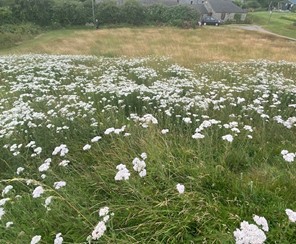
Similar in appearance, but a totally different species is Wild carrot, which has also popped up.
As its name suggests, this is the ancestor of the carrots we eat today and like almost all wildflowers it goes under a multitude of common names depending on which part of the country you happen to be in; one such name is Queen Anne’s lace.
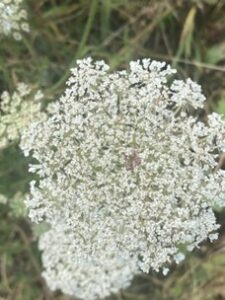
The flower head is actually a flat composite of hundreds of tiny individual flowers called an umbel. Invariably it has one pink or red flower right in the middle, apparently where Queen Anne pricked her finger when working on her lace.
Another flower with a dubious naming history is Hawkbit.
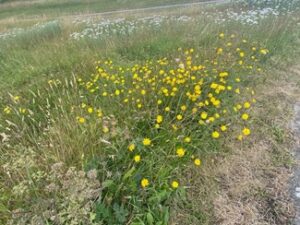
The flower looks similar to a dandelion and many people might mistake it for such, but it is not. A dandelion has a flowerhead on a short, fleshy hollow stalk; this one has multiple heads on long wiry stalks.
In medieval times it was believed that hawks would eat it to improve their eyesight, thus the name. It’s far more likely that the hawk used its perfectly adequate vision to swoop down on a mouse or a vole scurrying around under the plant.
But for archaic and quirky flower names it’s hard to beat this one:
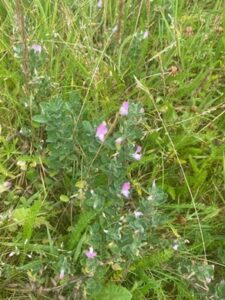
This small and unassuming plant is Restharrow. Anyone who thinks it looks a bit like a pea is absolutely right, It’s a member of the same family.
An explanation of the name is necessary. A harrow, specifically a grass harrow, was a horsedrawn implement which was basically a mat of chain with downward facing spikes, used to invigorate grassland. The spikes would drag through the meadow scarifying and scratching up dead grass to encourage fresh growth. Until it got to this.
Restharrow has very tough roots which form a dense, shallow mat. The poor old horse would be quite happily plodding along until it hit this; the harrow would come to rest, or be arrested, whichever you choose. Either way it probably wasn’t the horse’s favourite plant, but it’s quite fitting to have it here on an agricultural heritage site.
Final plant of the month is Knapweed
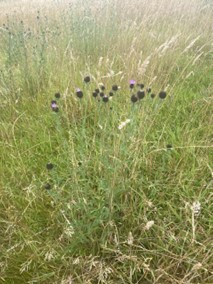
It doesn’t look like much here because it’s one of the last, and most important, wildflowers of the year and is only just coming into flower.
One of the three most nectar rich wildflowers in the Irish landscape, this will be a magnet for bees, particularly the Red tailed bumblebee for the rest of the summer. It’s no accident that this is the flower that features on the All Ireland Pollinator signs.
Watch this space…
Read more about Sustainability at Skerries Mills https://www.skerriesmills.ie/a-heritage-site-rooted-in-sustainability-and-biodiversity/